
From Heroics to Architecture
Why Scalable Organisations Cannot Rely on Exceptional People Alone
Scalable organisations convert personal judgement, effort and intervention into repeatable capability that does not depend on constant rescue.
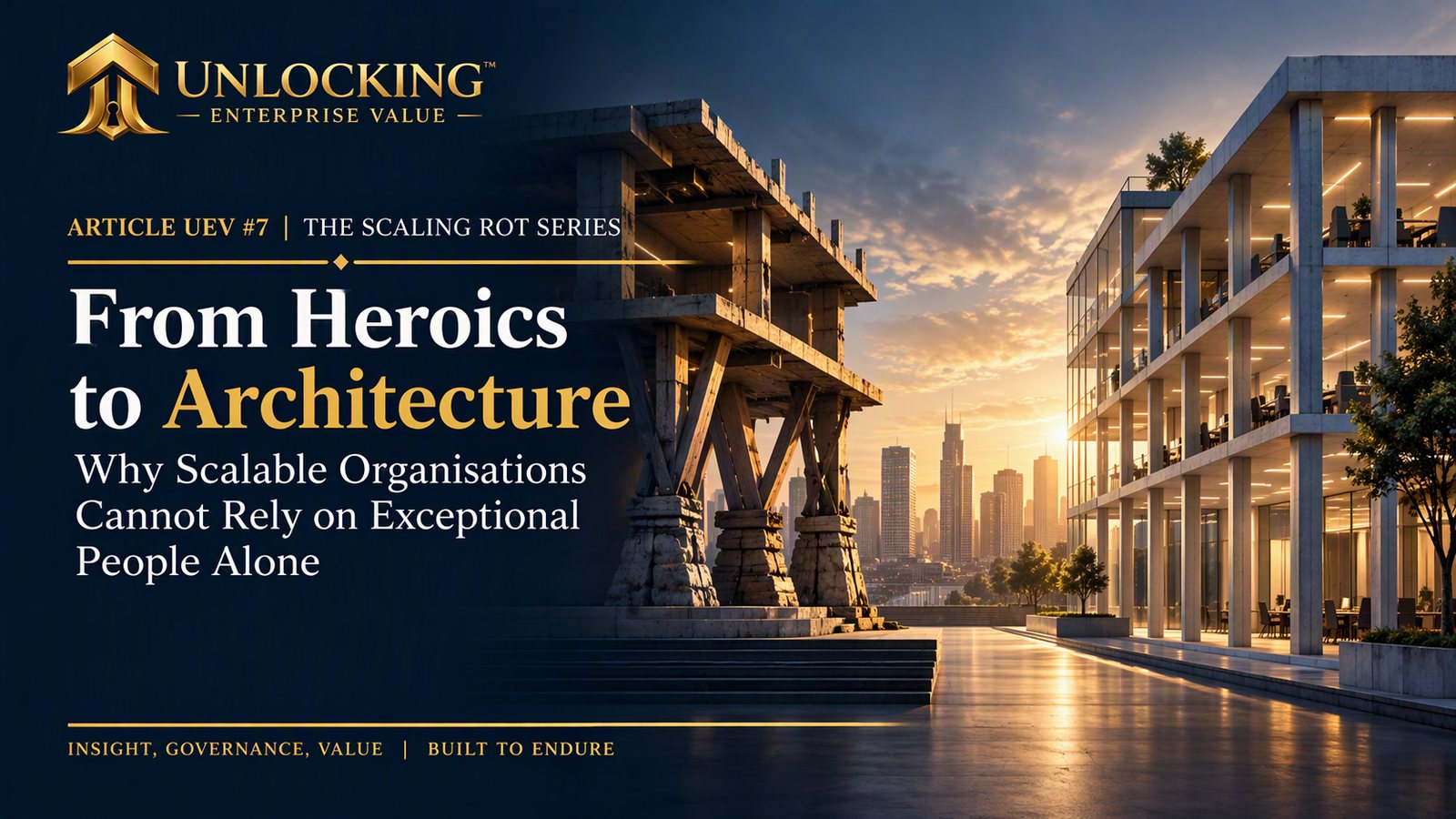
Most organisations scale on effort far longer than they realise. Talented leaders compensate, decisions escalate and get resolved, problems are absorbed, and momentum continues. From the outside, this looks like strength. From the inside, it is often a warning sign. Because the reliance on exceptional people to hold the system together is not a mark of scalability. It is a sign that the organisation has begun to substitute heroics for architecture.
Why heroics are mistaken for maturity
In the earlier stages of growth, heroics can be adaptive. Strong leaders bridge gaps while structure catches up. Informal authority moves work faster than formal processes. Judgment compensates for design that is still evolving. At scale, however, the same pattern becomes a liability. When performance depends on personal intervention rather than embedded capability, the organisation may continue to deliver, but at rising cost. Decision speed slows, coordination effort increases, succession risk concentrates, and strategic capacity narrows.
What once felt like leadership strength becomes organisational dependency. And dependency does not scale.
The invisible limits of heroic organisations
Heroic organisations tend to share a common profile. Execution improves when specific individuals are present and degrades when they are not. Escalation substitutes for clarity. Leaders spend disproportionate time arbitrating issues the system should resolve. Performance is sustained, but only through energy, experience, and personal authority. The organisation moves-but it does not compound. This is the point at which growth begins to work against the enterprise. McKinsey’s long-running research on organisational performance shows that sustained success is far more strongly correlated with institutional capability and organisational health than with individual excellence, particularly as complexity increases (McKinsey, 2019; McKinsey, 2023). Harvard Business Review’s work on transformation similarly shows that even organisations with strong leaders struggle to capture value when operating models are not redesigned to support scale (Argenti et al., 2021).
The evidence is consistent: leadership can carry misfit for a time. It cannot eliminate it.
What architecture actually enables
Architecture does not replace leadership. It amplifies it. Well-designed organisations do not eliminate judgment; they distribute it. They embed decision rights where information is richest. They reduce the need for escalation. They allow leaders to focus on direction, capability, and adaptation rather than constant intervention. In architectural organisations: capability carries strategy, not effort. Speed is a system outcome, not a leadership tax. Performance is repeatable, not rescued. Succession strengthens rather than destabilises execution.
This is what allows scaling to increase enterprise value rather than dilute it.
The Board’s role in the transition
Boards are often lulled by heroic performance, particularly when outcomes remain acceptable. But heroic dependency is not a neutral state. It silently accumulates risk. The Board’s responsibility is not to diminish strong leaders, but to ask whether the organisation is over-reliant on them. The most revealing questions are rarely about talent. They are about architecture:
Where does execution still depend on escalation rather than design?
Which decisions slow markedly when particular individuals are unavailable?
What strategic work requires more senior attention than it should?
When those answers point repeatedly to people rather than systems, the organisation is asking leadership to do structural work. That is not sustainable governance.
The arc of scalable organisations
Every organisation faces the same choice as it grows: Either leadership strength is converted into architecture-or it becomes a bottleneck disguised as excellence. The Scaling Rot is not caused by weak leaders. It is caused by strong leaders being left to carry what the organisation itself must eventually hold. The organisations that scale well are those that make the transition deliberately. They treat design as a strategic investment. They redesign early, before dependency hardens into fragility. They use their best leaders not as permanent load-bearing beams, but as architects of a system that can hold without them at its centre.
Because the final test of scale is not whether exceptional people are present. It is whether the enterprise performs when they are not.
Selected references
McKinsey & Company. The State of Organizations 2023.
McKinsey & Company. Perspectives on Transformation.
Argenti, Berman, Calsbeek and Whitehouse. The Secret Behind Successful Corporate Transformations. Harvard Business Review, 2021.
Continue through The Scaling Rot Series
Previous · UEV #6
← The Most Expensive Redesign Is the One You DelayNext
Quarterly Executive Briefing Volume 1 →Related thinking